Read the snow numbers
Snow depth vs snowfall: which number helps plan your ski day?
Snow depth vs snowfall vs SWE: what each measures, why 8 inches of new snow can raise depth by only 4, and which to compare.
By SkiBuds · Updated
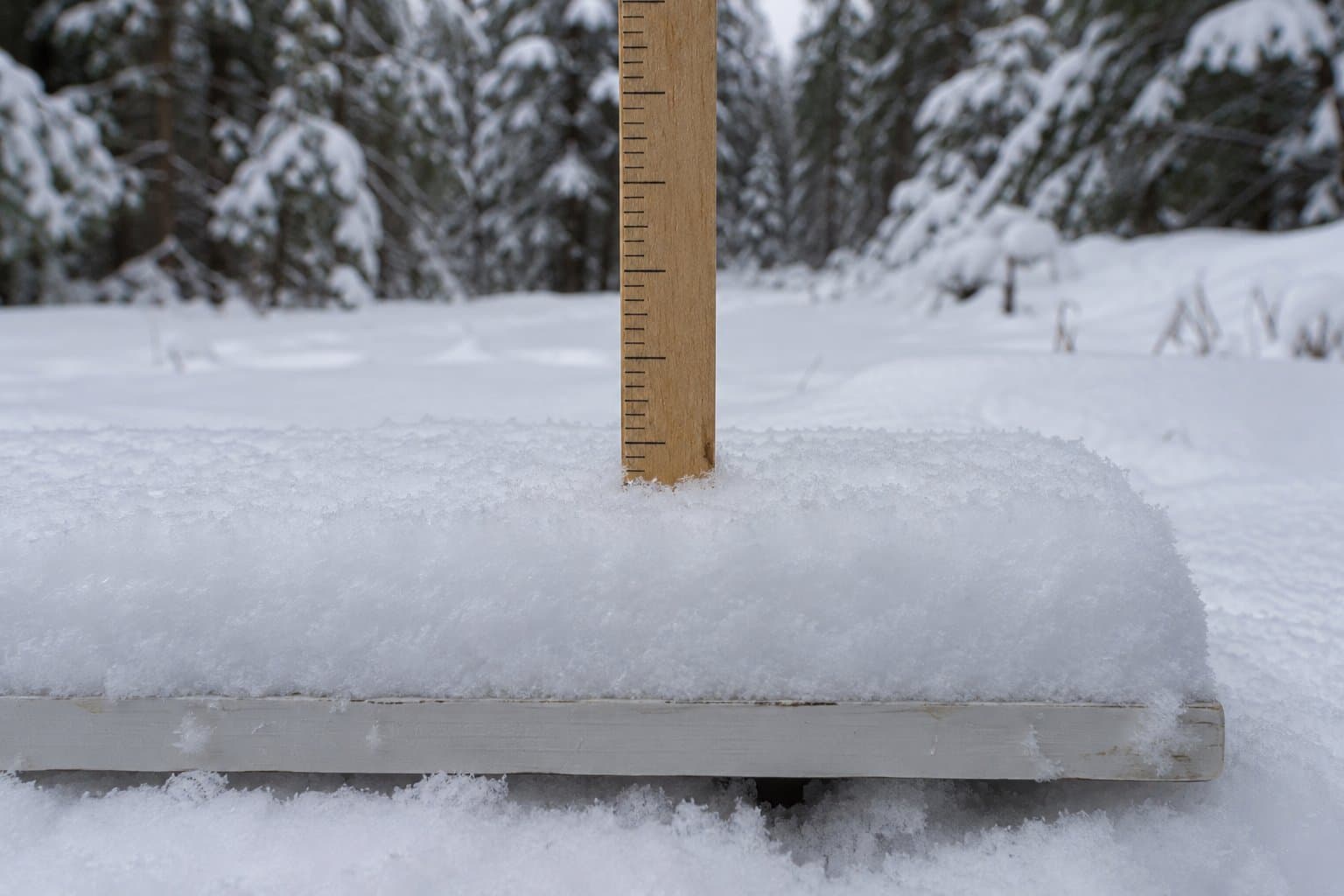
A storm can drop 8 inches of new snow and raise the snow stake by only 4, and both numbers can be right. Snowfall is how much new snow fell over a stated period. Snow depth is how much snow is on the ground right now at one spot. Snow water equivalent (SWE) is how much water that snow would melt into. The gap between the first two comes from how they're measured: new snow settles from the moment it lands, and National Weather Service observers can add up as many as four six-hour snowfall readings to make one daily total. For a ski day, compare new snowfall over the same hours to find fresh snow, and use depth to judge coverage.
Three numbers answer three different questions
| Number | What it describes | How to use it |
|---|---|---|
| New snowfall | Snow that falls over a stated period | Compare the same period, and tell a forecast from an observed report. |
| Snow depth | All the snow on the ground at one measurement point | Check where and when it was measured before treating it as mountain-wide coverage. |
| Snow water equivalent (SWE) | The water the snowpack would melt into | Read it as water content; it is neither snow depth nor fresh snowfall. |
A mountain can report a deep base while expecting little new snow, and a storm can bring a foot of snowfall while the depth stake rises by much less. Before your group compares mountains, agree on the question: fresh snow, existing coverage, or the water stored in the snowpack.
Why 8 inches of new snow can raise the depth by only 4
The NWS snow measurement guidelines explain most of the gap, because the two numbers are measured in different ways. Snowfall is read from a snowboard, a flat white board set on the snow. The observer records "the greatest amount of snowfall that has accumulated" on it, clears it no more than once every six hours, and is told to "never sum more than four, six-hourly observations" for a 24-hour total. The reason is in the next sentence: using more than four "would falsely increase snowfall totals." The rule-writers know that measuring more often makes the number bigger, so they cap it. Snow depth is measured once a day at the scheduled observation time, by reading a fixed snow stake or averaging several measuring-stick readings of all the snow on the ground, old and new, rounded to the nearest whole inch.
Here is a hypothetical storm day measured that way, with a 6 a.m. observation time. The observer reads the board at noon, 6 p.m., midnight and 6 a.m. and finds 3, 2, 2 and 1 inches. Snowfall for the day: 8 inches. The depth stake read 40 inches at 6 a.m. yesterday and reads 44 inches at 6 a.m. today. Both numbers are correct.
Each board reading catches snow within six hours of landing, before it has had long to settle. The snow on the ground has been settling the whole time. Researchers at Saint Louis University who studied 30 years of NWS snow records note that "considerable increases in snow density can take place within a 24-h period" as the crystals change shape and pack down (Baxter, Graves and Moore, 2005). Denser snow takes up less height.
Melting can widen the gap until the depth gains nothing at all. The NWS page gives the example of three snow squalls of 3.0, 2.2 and 1.5 inches, each melting before the next arrives. The day's snowfall is 6.7 inches, "even though the snow depth on your board at observation time was zero." Wind moves snow off one spot and onto another, which is why a single stake can miss what fell nearby.
That gap is also the first thing a skeptic points to when a resort's overnight total beats the rise in its base depth, and the skeptic's case is stronger than "the number looks big." The NWS rules exist because a snow total is easy to inflate. Clear the board every hour instead of every six and add up the readings, and the total grows; the NWS page says outright that more than four readings "would falsely increase snowfall totals." Measure where the wind piles snow, and it grows again; the same page tells observers to measure "where the effects of blowing and drifting are minimized" and, after strong wind, "where the snow was least affected by drifting." Those rules bind NWS observers. A resort's snow report is the resort's own measurement, and nothing on that page tells you how often a resort clears its board or where it sits.
So the gap alone proves nothing either way, because an honest observer following every rule can produce the same 8 inches of snowfall against 4 of depth. What settles it is a second number, measured over the same hours, that no board-clearing habit can touch. SWE is that number.
SWE tells you how much the snow weighs
Snow water equivalent is the depth of water you would have if the snow at a measurement point melted. Ten inches of snow that melts to one inch of water has an SWE of one inch, a 10:1 snow-to-water ratio. Avalanche.org puts a reasonable average near 12:1, wet "Sierra cement" around 5:1, and the lightest powder as high as 30:1, so two storms with the same SWE can leave very different depths. Snow-to-liquid ratio explained shows how temperature and wind change it.
The USDA NRCS SNOTEL network measures SWE automatically at more than 800 sites in remote, high-elevation watersheds of the western US. NOAA's drought portal describes how: a snow pillow at each station "measures how much water is in the snowpack by weighing the snow." Weighing sidesteps two of the problems above. Settling doesn't change weight, so snow that packs down from 8 inches to 4 weighs what it did when it landed, and a pillow has no board for anyone to clear.
That makes a SNOTEL station near a resort a rough check on its new-snow number. Divide the resort's overnight total by the station's SWE gain over the same hours. Eight inches against 0.6 inch of new water is about 13:1, close to avalanche.org's average. Eight inches against 0.2 inch is 40:1, past the top of avalanche.org's range, and a reason to ask where and how the 8 was measured. Treat a mismatch as a question rather than a verdict: the pillow sits in its own clearing at its own elevation, wind can still drift snow onto it or strip snow off it, and meltwater drains away. A SNOTEL reading is good evidence about a storm and weak evidence about the run you plan to ski.
Every snow number needs three labels: what, where and when
The measurement rules point to the fix. A snow number means something only when it carries three labels. What: new snow, base depth or SWE, and forecast or measured. Where: which station, stake or elevation, since a summit forecast and a mid-mountain stake describe different snow. When: which hours it covers and when it was issued or read. "The mountain has 12 inches" carries none of them, and it could mean new snow, base depth or a forecast. When you open a resort forecast, note its source, location and update time, and check terrain and lift openings with the resort itself, because snow totals don't tell you which runs will open.
Here is an example message with made-up numbers for Crystal Mountain:
Saturday at Crystal: forecast 6 in. new snow in the 12 hours ending 6 a.m. (NWS, updated Thu 3 p.m.). Base depth 52 in. at the mid-mountain stake (resort report, Thu 7 a.m.). Recheck Fri 6 p.m. If it holds, we leave at 6:30 and meet at the base lodge.
Every number in it says what it is, where it came from and when. The powder-day group plan turns a check like this into a meeting time, and the official weather, road and avalanche resources cover the parts of the trip a snow number can't answer.
The labels earn their keep on Friday at 6 p.m. Say the update cuts the forecast to 2 inches. Nobody has to ask which number changed: the new-snow forecast went from 6 to 2, the 52-inch base didn't move, and the group can decide in one message whether 2 inches on a deep base is still worth a 6:30 start.