Plan a day together
Ski and snowboard buddy meetup checklist
A checklist for a first ski meetup with someone new: a public meeting spot, a 15-minute wait rule, two easy laps with an exit and a message to copy.
By SkiBuds · Updated
Free · No account needed
Build your meetup message
Choose a mountain and a public meeting point. Create a message to share in your club or group conversation. Your entries stay in this page and clear when you reload.
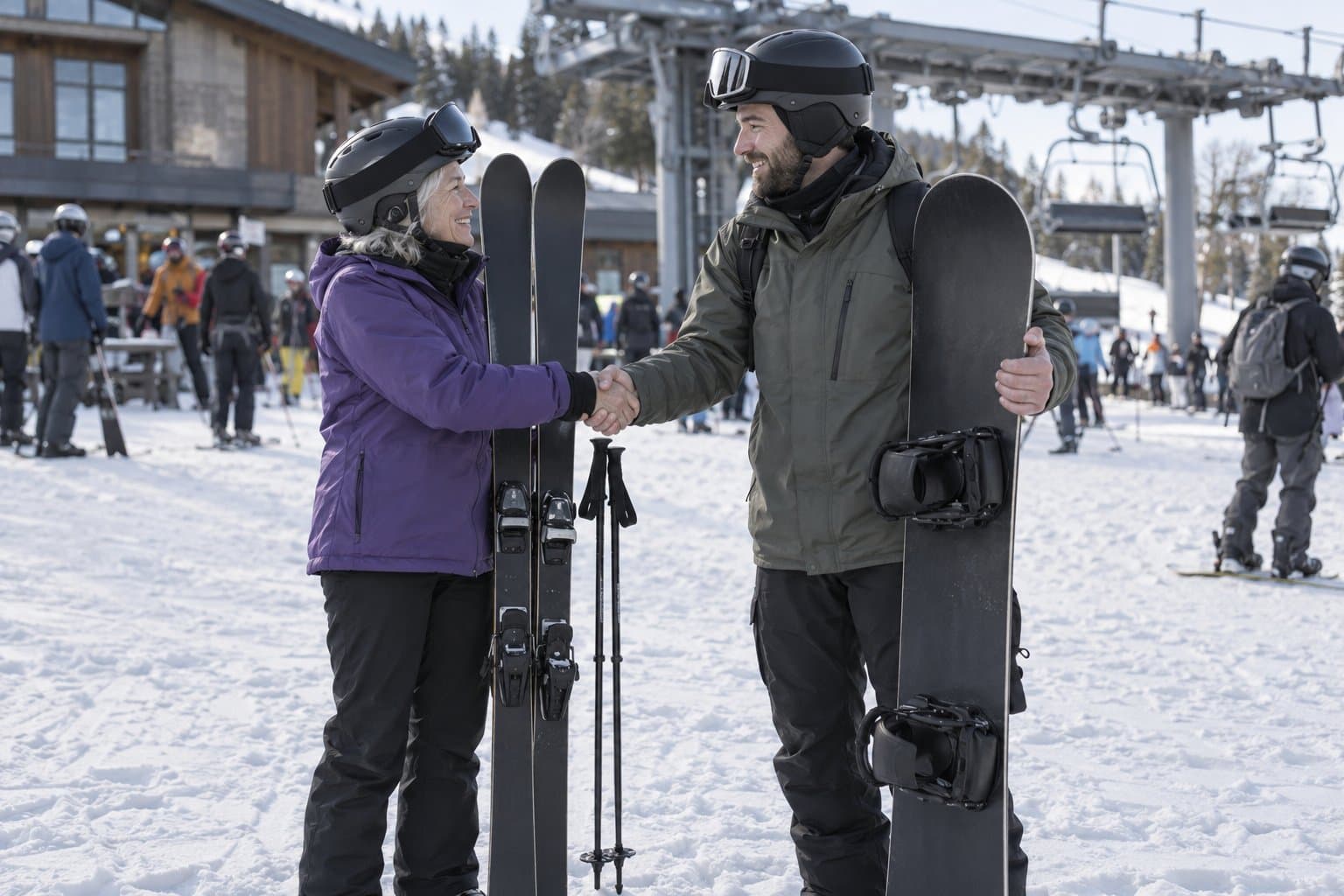
A first ski or snowboard meetup with someone new needs four things agreed in writing: an exact public meeting spot, a meeting time with a 15-minute wait rule, two easy warm-up laps, and a line that lets either person ride solo afterward, no reason needed. Put those four in one message and the rest of the day can stay loose. The free planner above writes that message for any mountain on this site, wait rule and solo line included, with no account needed.
Open the plain-text checklist to save, copy or print.
This checklist is for meeting at a resort. A first tour outside the boundary needs its own plan, starting with how to find a backcountry ski partner.
The first-meetup checklist
Before the day
- Resort, date and meeting time, in the mountain's local time.
- A named public spot at the base that someone who has never been there could walk to without asking: a lodge entrance, a ticket window, the bottom of a named lift. "The parking lot" fails that test.
- Lift access sorted for each person: pass, ticket or reservation.
- The runs each of you enjoys now, and the pace you like.
- How long the day is: a few laps, a morning, or until close.
- Transport: each person gets there on their own, or a shared car agreed separately.
- A friend who knows who you're riding with, where, and until when.
- A time the evening before to confirm, or to call it off.
At the base
- The wait rule: 15 minutes past the meeting time, one message, then go ride.
- Two warm-up laps a notch easier than either of you said you like.
- A regroup spot and time if you split up.
- A dead-phone plan: if you can't reach each other, go to the regroup spot at the agreed time.
Copy this first-meetup message
Here is the checklist turned into words, for a hypothetical Saturday at Timberline Lodge on Mount Hood. The resort's lessons page puts its ski and ride school desk on the first floor of the Wy'East Day Lodge, so that's the building lesson students are already sent to, and its main entrance passes the walk-there test:
"Ski and snowboard meetup at Timberline, Saturday [date]. We like groomed blues at a relaxed pace with breaks, riding until about 2. Meet outside the main entrance of the Wy'East Day Lodge at 9:00. Everyone sorts their own lift access and gets there on their own. Two easy laps to warm up, then we decide together, and anyone can ride solo after that, no reason needed. If someone's late we wait 15 minutes, then message. If we get split up, we regroup at the same door at noon. We'll check the mountain report Friday at 7 p.m. Who has a similar plan?"
Swap in your own details, or let the planner fill them in. For where to post it, see how to find ski buddies or meeting snowboard buddies.
The message ends with a promise to check, so keep it. At the time you named, open the resort's operating report and the forecast for the hours you'll ride, and post one line in the same thread: still on, or called off. If a storm is coming, the powder day planning guide adds a morning check with three answers: go, later or cancel.
Three lines in that message carry most of the weight: the wait, the solo exit and the noon regroup. They are also the three hardest to bring up once you're both standing at the lodge door.
Fifteen minutes turns a late arrival into a rule
A late arrival with no message can sour a first meetup before the first chair: traffic into the lot, a ticket-window line, a phone zipped into a pocket. Agreeing on a number in advance turns the wait from a judgment about the other person into a rule you both accepted. Fifteen minutes is arbitrary. It's long enough for a slow lot and a ticket line, and short enough that nobody loses the morning.
It isn't long enough for everything, and Timberline's own parking page shows what it can't cover. "During the busy winter season on weekends, our parking lots fill up quickly with ski area guests," it says, and it also suggests parking in Government Camp or the Mt. Hood Villages and catching a ride up on the Mt. Hood Express or the Timberline Resort Shuttle. The page doesn't say when the lots fill or how long that ride takes, so no wait you set in advance is sure to cover it. That's why the rule ends in a message and a meeting place instead of a longer wait. When the 15 minutes run out, send one message saying where you're riding and when you'll be back at the meeting spot, and go. Whoever was late, even from a shuttle seat, knows exactly where to find you.
The solo exit has to be agreed before the first chair
Once you've found each other, make the two warm-up runs easier than what either person described. One easy run shows more about someone's riding than any ability label, and nobody gets pushed on the first lap. At the bottom of the second, ask the plain question: more of the same, something harder, or split for a while? If your paces turn out to be far apart, the guide to riding with different abilities has a rule for splitting on a clock that still keeps the day shared.
The strongest objection is that writing an exit into a casual ski day makes it feel like a contract, as if you expect it to go badly. A plan for leaving does say out loud that leaving is possible, and some people will find that stiff. The alternative is worse. Without the line, someone has to improvise the same sentence at the top of a run, to a person who has just waited for them twice or watched them fall. Agreed in advance, "anyone can ride solo, no reason needed" is a courtesy to both people. Improvised, it feels like a rejection. And the exit is only easy to offer because the message already says where you'll find each other again.
Plan the regroup as if both phones will die
Both the wait and the exit lean on the regroup, so it has to work when a text can't. Apple says the iPhone is designed for ambient temperatures between 32° and 95° F and that colder conditions "might temporarily shorten battery life and could cause your device to turn off," and a chairlift ride at 20° F is outside that range. So the regroup is a named spot, a time, and the agreement that whoever can't reach the other goes there. Carry the phone in an inside pocket, close to your body, and carry the noon regroup in your head.
If you only know them online, get there on your own
All three lines assume each of you reached the mountain separately. With someone you met online, keep it that way: get yourself there if you can, so nobody depends on a near-stranger for the drive home. Keep the meeting in a busy public spot at the base, in daylight, and tell a friend who you're meeting and when you expect to be done. If you do share a ride with someone you've only talked to online, meet at a public pickup spot such as a park-and-ride, not a home address. The SkiBuds safety page covers these habits and the reporting and blocking tools the rebuilt app, coming soon, will have. For seats, gear and costs, the ski carpool planning guide works through a cost split with real prices.
Read yours back as a stranger, then send it
Now write yours. Put your own spot, meeting time and regroup time into the message, then read those three back as a stranger would. They should be able to walk to the spot without asking anyone, and know where to stand at the regroup time with a dead phone. If both hold, send it.