Plan a day together
How to plan a powder day with ski and snowboard friends
Plan a powder day with friends: pick the mountain the night before on the low-end snow forecast, and let the morning check say go, later or cancel.
By SkiBuds · Updated
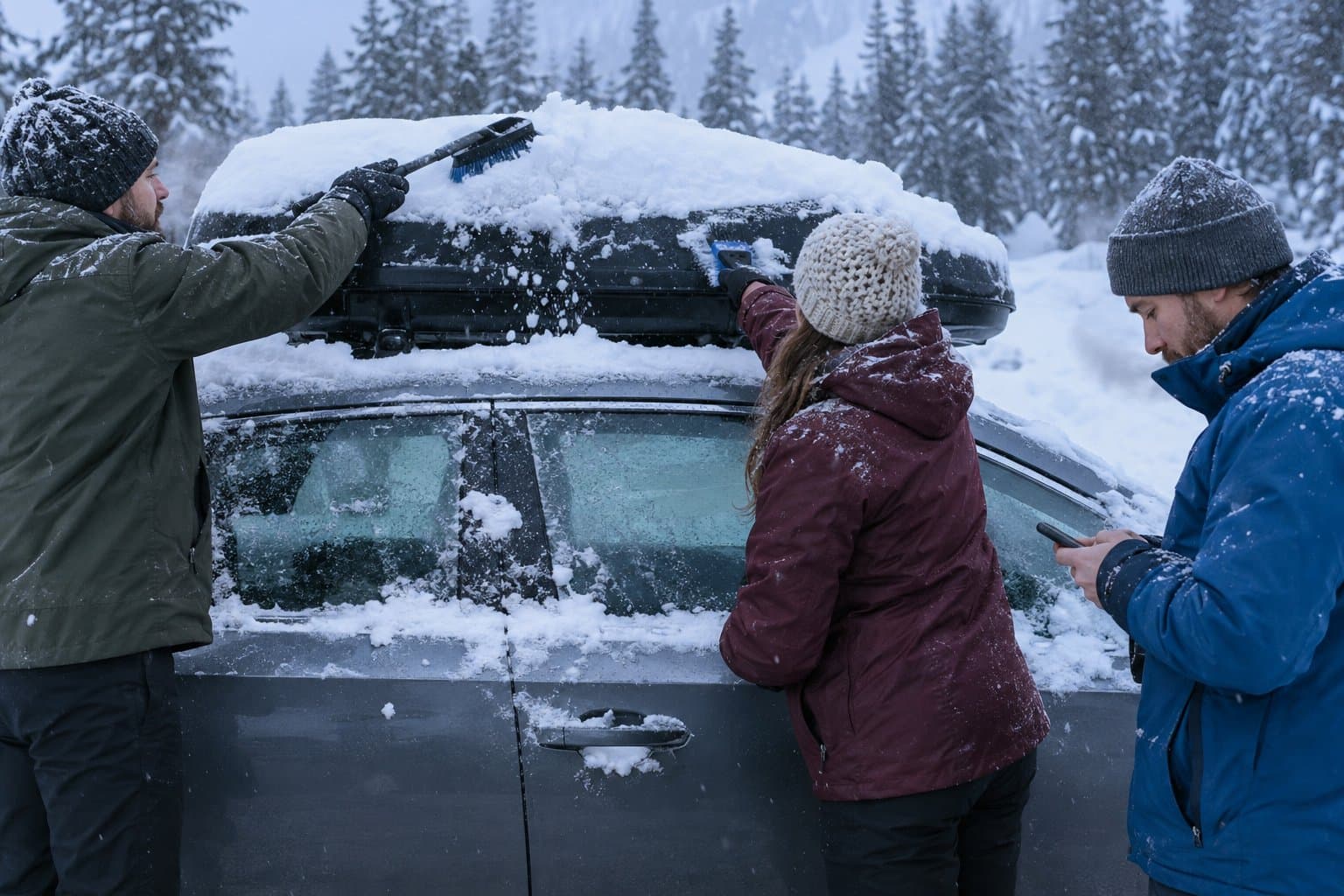
Plan a powder day with friends by making the big decision the night before. Pick the mountain on the low end of the snow forecast, the amount the National Weather Service gives a 9 in 10 chance of being beaten, agree on a departure time, and let the morning check choose between only three answers: go, leave later or cancel. Switching mountains isn't one of them. A group that tries to pick a mountain at 5 a.m. can easily end up in two cars heading two ways.
This guide is for a lift-served resort day. A snowfall forecast says nothing about avalanche danger; for travel beyond the resort boundary, start with how to read an avalanche forecast.
Plan on the low end of the snow forecast
A single snow total hides how sure the forecaster is. The National Weather Service's probabilistic snowfall pages, experimental products covering the contiguous U.S. and Alaska, add the missing piece: an expected amount alongside a low end and a high end. The NWS fact sheet for these pages walks through one forecast for the town of Jackson, Wyoming. The expected snowfall was 2.5 inches. The low end was 1 inch, meaning a 90% chance that more would fall, and the high end was 4, with a 90% chance that less would. When the two ends sit close together there is greater confidence in the amount, and when they are far apart there is "less confidence and more uncertainty in the forecast."
That gives a group a decision rule. Choose a mountain you would still be glad to drive to if only the low end falls. If the low end alone justifies a long drive, take it. If it takes the expected or high-end number to make the trip worthwhile, choose the closer mountain.
A forecast read, worked through
Here's a hypothetical. On Friday evening your group looks at a Saturday storm that covers two resorts, one three hours away and one 90 minutes away. The NWS page shows about the same numbers for both: an expected 8 inches overnight, a low end of 3 and a high end of 14.
A spread from 3 to 14 is wide, so confidence is low. Three inches wouldn't justify three hours of driving for most groups, so the far resort fails the low-end test. You pick the closer mountain and set departure for 6:15. If the storm overdelivers, the closer mountain gets it too. If it underdelivers, you saved three hours of driving. The answer changes only if the far resort's low end is clearly higher, so compare the two pages before assuming they match.
The strongest objection is that the rule is timid. Some of the best days of a season come from long drives on uncertain forecasts, and a group that only drives far when the low end justifies it will skip some of them. That's a real cost. If everyone in the car would rather gamble three hours on the expected number, plan on that instead. What the rule protects is the agreement: whichever number you plan on, you choose it together the night before, so nobody reopens it in the dark beside the car.
Before you commit, check what the numbers leave out. The NWS example was a forecast for the town of Jackson, and a town, a base and a summit can get different totals from one storm, so find out which elevation your number describes. Check the hours too: snow that falls overnight and stops at dawn makes a different day from snow that starts at 10 a.m. And no snowfall number says whether the upper lifts will run in the wind. How to read a ski resort snow forecast walks through period, elevation and wind, and why snow forecasts disagree covers what to do when two sources don't match.
The morning check: go, later, or cancel
A forecast can't tell you what's open. Before anyone drives, one person opens three things and posts them in the group chat with the time they checked:
- The resort's operating report, for the lifts and terrain actually open. A forecast is not a lift announcement.
- The overnight snow report, which is a measurement rather than a forecast.
- The road service for the route, for closures and any chain or traction rules, which matter most on exactly these mornings.
Then the group picks one of three answers. Go as planned. Leave later, if the road is closed or the snow is still coming down hard. Or cancel. Switching mountains stays off the list unless everyone agreed to it the night before, because a reroute at 5:45 is how carpools strand people. The official resources page links road services by region.
The weak spot in this check is "later." On a morning when the road stays closed, later can stretch into an hour of refreshing the road report, and nobody wants to be the one who says cancel. So give it an expiry tonight: if the road hasn't opened by a time you all agree on, later becomes cancel.
If you share a car, put the return time and costs in the same conversation; the ski carpool planning guide has a worked cost split. For a crew riding together for the first time, deep snow doesn't replace a talk about terrain and a regrouping point, which the first meetup checklist covers.
SkiBuds is being rebuilt to put mountain weather and opt-in powder alerts next to finding people to ride with. The app is coming soon; the resort forecasts and guides on this site work now.
Agree on the wait and the trees tonight
Powder mornings test patience. Decide in the plan how long the group waits at the base for someone running late, and whether you ride the trees in pairs. The SkiBuds post no friends on a powder day? argues for a five-minute wait at the base and a partner in sight in the trees, with the deep-snow safety sources behind it.
A group update you can copy
"Saturday: [resort]. Forecast checked at [time] from [source]: expected [amount], low end [amount], high end [amount], mostly [overnight / during the day]. Leaving [pickup spot] at [time]. Morning check at [time]: go, later or cancel, no switching mountains. Later becomes cancel if the road isn't open by [time]. At the base we wait [minutes] for anyone late. Trees in pairs. Heading home at [time]."
Send it by 8 p.m. the night before, with the low-end number filled in. If that number alone wouldn't get your group in the car for the far drive, the mountain in the first bracket is the near one, unless everyone already chose the gamble tonight. Either way, nothing said at 5:45 changes it.