Plan a day together
Skiing and snowboarding with friends of different abilities
A rule for mixed-ability ski days: the least confident rider picks the shared runs, others split off on a clock, and everyone regroups somewhere easy.
By SkiBuds · Published · Updated · Sources & corrections
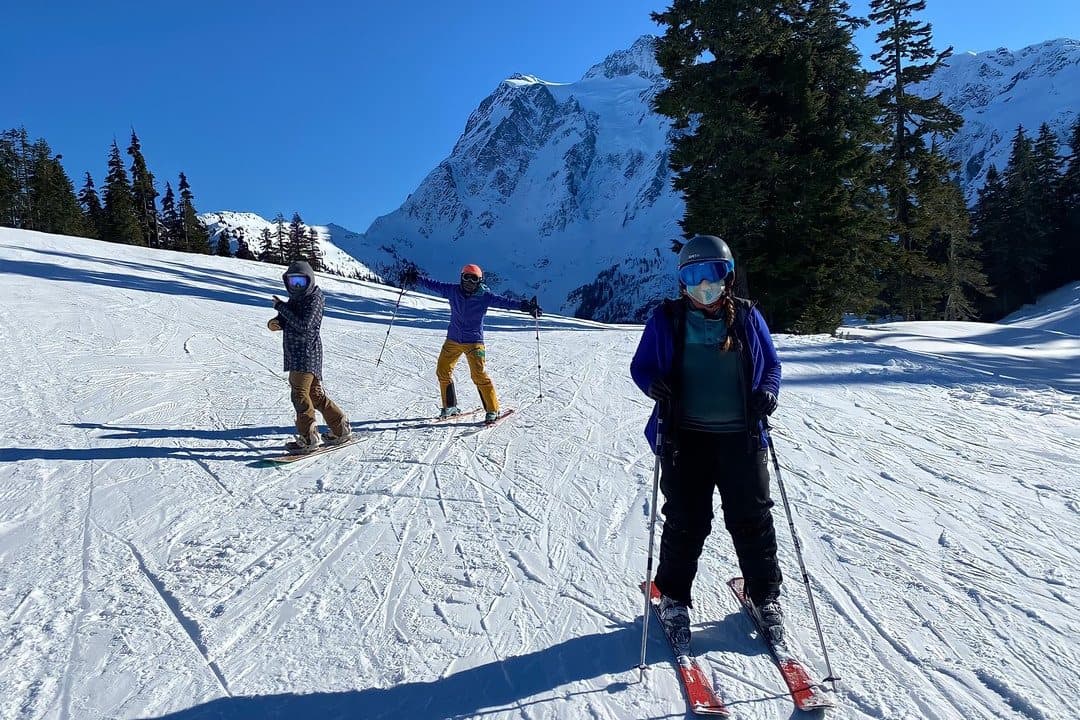
Skiing with friends of different abilities works when you split up on purpose. Use one rule: the least confident rider picks the shared runs, the stronger riders take their own laps on a clock ("back at the gondola at 12:30"), and everyone meets again at a place they can all reach without riding anything new. You still share the lifts, lunch and a few laps, and nobody spends the day on terrain that is wrong for them.
That runs against the instinct to stay together all day. Staying together all day risks one of two bad days: the newer rider gets pulled onto runs they can't control, or the strongest rider spends six hours on the same green. The first one is the dangerous one. The NSAA Responsibility Code opens with "Always stay in control," and following a friend onto a run you wouldn't choose alone is a quick way to stop being in control.
Why "I ski blues" doesn't tell you enough
Each resort rates its trails against its own other runs. Timberline Lodge in Oregon says so on its trail signage page: the same symbols are used at every resort in the country, but "A Green Circle trail at Jackson Hole, Wyo., might be as tough as a Blue Square at Sunlight, Colo." The same page says the ratings are consistent within each resort, so a blue at your home hill is a fair guide to other blues there and a weak guide anywhere else. The symbols are national. The difficulty behind them is local.
Right after the Jackson Hole comparison, the page calls the difference "Not a big deal." For one rider who knows their home hill, it mostly isn't. For a group choosing shared runs at a mountain the newest rider has never seen, it's the whole problem, and the page leaves out the one thing that would solve it: what makes a run green, blue or black. Without that, there's no way to convert one resort's blue into another's.
The snow changes the answer as well. A rating stays the same all season while the surface under it changes overnight, and the same blue is a different run on soft corduroy and on morning ice, so judge the shared runs on today's snow.
So ask better questions before the first chair. Which runs at this mountain, or at your home mountain, do you enjoy right now? How do you feel about ice, moguls or a narrow catwalk? Do you want to learn today or just cruise? How long until your legs are done, and has anyone booked a lesson? The answers beat any color a rider gives themselves. On a hard-packed or icy day, move everyone's comfortable terrain down a notch.
The split-and-regroup rule
- The least confident rider picks the shared runs, judged on today's snow.
- Ride two shared laps, then ask. If the newest rider is happy repeating them and someone else wants something harder, split.
- Split on a clock, not a count. "Back here at 12:30" works. "See you after a few runs" doesn't, because a few runs on a slow lift and a few on a fast one are different hours.
- Regroup somewhere everyone can reach on terrain they have already ridden: the bottom of a lift the whole group used, the top of a gondola, a named lodge. Never a spot that needs the newer rider to find a new way down.
- The rider who goes farthest owns the timing, and leaves enough margin to get back before connecting lifts close.
- Nobody follows anyone onto a run they wouldn't pick alone. "I'll meet you at the bottom" is always allowed.
Put the regroup time and place in the group chat before you split, along with a plan for a dead phone, such as waiting at the meeting point for 15 minutes before checking the nearest lodge.
A timed split does not replace a riding partner in ungroomed terrain. Deep Snow Safety advises keeping a partner in sight there. If one rider wants trees or deep snow and the others do not, arrange a suitable partner or choose another run; a lunch appointment cannot help someone who disappears into a tree well.
Why meeting at the bottom is not enough explains what a riding partner needs to be able to see and hear between regroup stops.
Skiers and snowboarders change where you regroup
Skiers and snowboarders move differently through a resort. Flat connections cost a snowboarder more, and strapping in at the top of each lift takes a minute, so pick regroup spots just off the lift rather than halfway down a run, and leave long traverses out of the shared laps. If the park is part of the plan, agree whether everyone goes or whether the park riders meet the group afterward.
Check the resort's sport policy before you pick it. Alta says "Snowboarding is not allowed," and Deer Valley calls itself "a ski only resort." The Utah mountain guide marks the difference in its resort list.
What this looks like at one mountain
Say three friends spend a day at Keystone in Colorado: a skier on her fourth day, a snowboarder comfortable on groomed blues, and a skier who wants bumps and trees. Keystone describes Dercum Mountain as long, groomed beginner runs such as Schoolmarm plus wide intermediate runs, with learning zones at the top of the River Run Gondola. North Peak is pitched at intermediate to advanced riders, with long bump runs. The Outback is the farthest and tallest of the three peaks, known for trees and powder.
The morning goes on Dercum. The newest skier picks the runs, the snowboarder works the wider blues nearby, and the regroup point is the top of the gondola, which everyone has already reached. At 10:30 the strong skier takes a separate session, with lunch back on Dercum at 12:30. A move into trees or deep snow depends on having a suitable partner who stays in sight; otherwise he chooses open groomed runs within his ability. He still owns the job of returning on time. After lunch the group returns to shared laps until the newest skier calls it. Before splitting, check the current trail map and lift report, because which lifts link the peaks, and until when, changes with the day.
Doesn't splitting up defeat the point?
The best case for staying together is that following a stronger friend can make a newer rider better. Watching someone link turns one notch steeper than you'd choose can teach more than a morning of repeating the same green, and some riders would rather be pushed a little than parked. That's fair, and the rule leaves room for it. A shared lap on the hardest run the newer rider would pick alone, with the stronger rider leading slowly, is exactly that kind of push. The line sits at runs the newer rider wouldn't pick without the group, because that's where following stops being practice and starts testing the Code's first line.
The rule has a weak spot of its own. Putting the least confident rider in charge can lead them to pick runs below what they'd enjoy, just so nobody waits on them. If you see that happening, split earlier, so they choose the next few runs without an audience.
Splitting also takes less of the day than it sounds. In the Keystone plan the group is apart for two hours, and the rest is shared lifts, shared laps and one lunch table.
Let lessons remain lessons
A good riding friend isn't automatically a good instructor, and the friendship pays for the experiment. If someone wants to learn, book a lesson and plan the rest of the group's morning around it, meeting where the lesson ends.
If this is someone's first or second day, the beginner ski buddy guide covers finding people at the same stage and arranging lunch around a lesson, without promising shared runs before the learner is ready.
For a friend coming back after a long break, getting ready for ski season covers gear and an easy first day. When the group includes someone you haven't ridden with, use the first meetup planner to put the meeting and regroup details in one message. If you're looking for beginner ski buddies or snowboard friends, put your current terrain and pace in the first message so people with a similar day can answer.
The rule in one message
The whole rule fits in one line you can send the night before: "Shared laps on whatever [name] picks, split at [time], back at [place] by [time]." Fill in the brackets, send it, and in the morning let the least confident rider choose the first run.